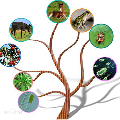

The possibility for humans to interact with physical or virtual systems using gestures has been vastly explored by researchers and designers in the last twenty years to provide new and intuitive interaction modalities. Unfortunately, the literature about gestural interaction is not homogeneous, and it is characterised by a lack of shared terminology. This leads to fragmented results and makes it difficult for research activities to build on top of state-of-the-art results and approaches. The analysis in this paper aims at creating a common conceptual design framework to enforce development efforts in gesture-based human-machine interaction. The main contributions of the paper can be summarised as follows: (i) we provide a broad definition for the notion of functional gesture in human-machine interaction, (ii) we design a flexible and expandable gesture taxonomy, and (iii) we put forward a detailed problem statement for gesture-based human-machine interaction. Finally, to support our main contribution, the paper presents, and analyses 83 most pertinent articles classified on the basis of our taxonomy and problem statement.
相關內容
分類學是分類的實踐和科學。Wikipedia類別說明了一種分類法,可以通過自動方式提取Wikipedia類別的完整分類法。截至2009年,已經證明,可以使用人工構建的分類法(例如像WordNet這樣的計算詞典的分類法)來改進和重組Wikipedia類別分類法。
從廣義上講,分類法還適用于除父子層次結構以外的關系方案,例如網絡結構。然后分類法可能包括有多父母的單身孩子,例如,“汽車”可能與父母雙方一起出現“車輛”和“鋼結構”;但是對某些人而言,這僅意味著“汽車”是幾種不同分類法的一部分。分類法也可能只是將事物組織成組,或者是按字母順序排列的列表;但是在這里,術語詞匯更合適。在知識管理中的當前用法中,分類法被認為比本體論窄,因為本體論應用了各種各樣的關系類型。
在數學上,分層分類法是給定對象集的分類樹結構。該結構的頂部是適用于所有對象的單個分類,即根節點。此根下的節點是更具體的分類,適用于總分類對象集的子集。推理的進展從一般到更具體。
Interactive machine learning (IML) is a field of research that explores how to leverage both human and computational abilities in decision making systems. IML represents a collaboration between multiple complementary human and machine intelligent systems working as a team, each with their own unique abilities and limitations. This teamwork might mean that both systems take actions at the same time, or in sequence. Two major open research questions in the field of IML are: "How should we design systems that can learn to make better decisions over time with human interaction?" and "How should we evaluate the design and deployment of such systems?" A lack of appropriate consideration for the humans involved can lead to problematic system behaviour, and issues of fairness, accountability, and transparency. Thus, our goal with this work is to present a human-centred guide to designing and evaluating IML systems while mitigating risks. This guide is intended to be used by machine learning practitioners who are responsible for the health, safety, and well-being of interacting humans. An obligation of responsibility for public interaction means acting with integrity, honesty, fairness, and abiding by applicable legal statutes. With these values and principles in mind, we as a machine learning research community can better achieve goals of augmenting human skills and abilities. This practical guide therefore aims to support many of the responsible decisions necessary throughout the iterative design, development, and dissemination of IML systems.
Readability assessment is the task of evaluating the reading difficulty of a given piece of text. Although research on computational approaches to readability assessment is now two decades old, there is not much work on synthesizing this research. This article is a brief survey of contemporary research on developing computational models for readability assessment. We identify the common approaches, discuss their shortcomings, and identify some challenges for the future. Where possible, we also connect computational research with insights from related work in other disciplines such as education and psychology.

Human-AI co-creativity involves both humans and AI collaborating on a shared creative product as partners. In a creative collaboration, interaction dynamics, such as turn-taking, contribution type, and communication, are the driving forces of the co-creative process. Therefore the interaction model is a critical and essential component for effective co-creative systems. There is relatively little research about interaction design in the co-creativity field, which is reflected in a lack of focus on interaction design in many existing co-creative systems. The primary focus of co-creativity research has been on the abilities of the AI. This paper focuses on the importance of interaction design in co-creative systems with the development of the Co-Creative Framework for Interaction design (COFI) that describes the broad scope of possibilities for interaction design in co-creative systems. Researchers can use COFI for modeling interaction in co-creative systems by exploring alternatives in this design space of interaction. COFI can also be beneficial while investigating and interpreting the interaction design of existing co-creative systems. We coded a dataset of existing 92 co-creative systems using COFI and analyzed the data to show how COFI provides a basis to categorize the interaction models of existing co-creative systems. We identify opportunities to shift the focus of interaction models in co-creativity to enable more communication between the user and AI leading to human-AI partnerships.
Designers reportedly struggle with design optimization tasks where they are asked to find a combination of design parameters that maximizes a given set of objectives. In HCI, design optimization problems are often exceedingly complex, involving multiple objectives and expensive empirical evaluations. Model-based computational design algorithms assist designers by generating design examples during design, however they assume a model of the interaction domain. Black box methods for assistance, on the other hand, can work with any design problem. However, virtually all empirical studies of this human-in-the-loop approach have been carried out by either researchers or end-users. The question stands out if such methods can help designers in realistic tasks. In this paper, we study Bayesian optimization as an algorithmic method to guide the design optimization process. It operates by proposing to a designer which design candidate to try next, given previous observations. We report observations from a comparative study with 40 novice designers who were tasked to optimize a complex 3D touch interaction technique. The optimizer helped designers explore larger proportions of the design space and arrive at a better solution, however they reported lower agency and expressiveness. Designers guided by an optimizer reported lower mental effort but also felt less creative and less in charge of the progress. We conclude that human-in-the-loop optimization can support novice designers in cases where agency is not critical.
Graph machine learning has been extensively studied in both academic and industry. However, as the literature on graph learning booms with a vast number of emerging methods and techniques, it becomes increasingly difficult to manually design the optimal machine learning algorithm for different graph-related tasks. To tackle the challenge, automated graph machine learning, which aims at discovering the best hyper-parameter and neural architecture configuration for different graph tasks/data without manual design, is gaining an increasing number of attentions from the research community. In this paper, we extensively discuss automated graph machine approaches, covering hyper-parameter optimization (HPO) and neural architecture search (NAS) for graph machine learning. We briefly overview existing libraries designed for either graph machine learning or automated machine learning respectively, and further in depth introduce AutoGL, our dedicated and the world's first open-source library for automated graph machine learning. Last but not least, we share our insights on future research directions for automated graph machine learning. This paper is the first systematic and comprehensive discussion of approaches, libraries as well as directions for automated graph machine learning.
Despite its great success, machine learning can have its limits when dealing with insufficient training data. A potential solution is the additional integration of prior knowledge into the training process which leads to the notion of informed machine learning. In this paper, we present a structured overview of various approaches in this field. We provide a definition and propose a concept for informed machine learning which illustrates its building blocks and distinguishes it from conventional machine learning. We introduce a taxonomy that serves as a classification framework for informed machine learning approaches. It considers the source of knowledge, its representation, and its integration into the machine learning pipeline. Based on this taxonomy, we survey related research and describe how different knowledge representations such as algebraic equations, logic rules, or simulation results can be used in learning systems. This evaluation of numerous papers on the basis of our taxonomy uncovers key methods in the field of informed machine learning.
Deep Learning has implemented a wide range of applications and has become increasingly popular in recent years. The goal of multimodal deep learning is to create models that can process and link information using various modalities. Despite the extensive development made for unimodal learning, it still cannot cover all the aspects of human learning. Multimodal learning helps to understand and analyze better when various senses are engaged in the processing of information. This paper focuses on multiple types of modalities, i.e., image, video, text, audio, body gestures, facial expressions, and physiological signals. Detailed analysis of past and current baseline approaches and an in-depth study of recent advancements in multimodal deep learning applications has been provided. A fine-grained taxonomy of various multimodal deep learning applications is proposed, elaborating on different applications in more depth. Architectures and datasets used in these applications are also discussed, along with their evaluation metrics. Last, main issues are highlighted separately for each domain along with their possible future research directions.
Machine learning plays a role in many deployed decision systems, often in ways that are difficult or impossible to understand by human stakeholders. Explaining, in a human-understandable way, the relationship between the input and output of machine learning models is essential to the development of trustworthy machine-learning-based systems. A burgeoning body of research seeks to define the goals and methods of explainability in machine learning. In this paper, we seek to review and categorize research on counterfactual explanations, a specific class of explanation that provides a link between what could have happened had input to a model been changed in a particular way. Modern approaches to counterfactual explainability in machine learning draw connections to the established legal doctrine in many countries, making them appealing to fielded systems in high-impact areas such as finance and healthcare. Thus, we design a rubric with desirable properties of counterfactual explanation algorithms and comprehensively evaluate all currently-proposed algorithms against that rubric. Our rubric provides easy comparison and comprehension of the advantages and disadvantages of different approaches and serves as an introduction to major research themes in this field. We also identify gaps and discuss promising research directions in the space of counterfactual explainability.
Machine learning techniques have deeply rooted in our everyday life. However, since it is knowledge- and labor-intensive to pursue good learning performance, human experts are heavily involved in every aspect of machine learning. In order to make machine learning techniques easier to apply and reduce the demand for experienced human experts, automated machine learning (AutoML) has emerged as a hot topic with both industrial and academic interest. In this paper, we provide an up to date survey on AutoML. First, we introduce and define the AutoML problem, with inspiration from both realms of automation and machine learning. Then, we propose a general AutoML framework that not only covers most existing approaches to date but also can guide the design for new methods. Subsequently, we categorize and review the existing works from two aspects, i.e., the problem setup and the employed techniques. Finally, we provide a detailed analysis of AutoML approaches and explain the reasons underneath their successful applications. We hope this survey can serve as not only an insightful guideline for AutoML beginners but also an inspiration for future research.
Our experience of the world is multimodal - we see objects, hear sounds, feel texture, smell odors, and taste flavors. Modality refers to the way in which something happens or is experienced and a research problem is characterized as multimodal when it includes multiple such modalities. In order for Artificial Intelligence to make progress in understanding the world around us, it needs to be able to interpret such multimodal signals together. Multimodal machine learning aims to build models that can process and relate information from multiple modalities. It is a vibrant multi-disciplinary field of increasing importance and with extraordinary potential. Instead of focusing on specific multimodal applications, this paper surveys the recent advances in multimodal machine learning itself and presents them in a common taxonomy. We go beyond the typical early and late fusion categorization and identify broader challenges that are faced by multimodal machine learning, namely: representation, translation, alignment, fusion, and co-learning. This new taxonomy will enable researchers to better understand the state of the field and identify directions for future research.
小貼士
登錄享
相關主題




注冊地址: 北京市海淀區羊坊店路18號2幢3層301-191