

SHAP (SHapley Additive exPlanation) values provide a game theoretic interpretation of the predictions of machine learning models based on Shapley values. While exact calculation of SHAP values is computationally intractable in general, a recursive polynomial-time algorithm called TreeShap is available for decision tree models. However, despite its polynomial time complexity, TreeShap can become a significant bottleneck in practical machine learning pipelines when applied to large decision tree ensembles. Unfortunately, the complicated TreeShap algorithm is difficult to map to hardware accelerators such as GPUs. In this work, we present GPUTreeShap, a reformulated TreeShap algorithm suitable for massively parallel computation on graphics processing units. Our approach first preprocesses each decision tree to isolate variable sized sub-problems from the original recursive algorithm, then solves a bin packing problem, and finally maps sub-problems to single-instruction, multiple-thread (SIMT) tasks for parallel execution with specialised hardware instructions. With a single NVIDIA Tesla V100-32 GPU, we achieve speedups of up to 19x for SHAP values, and speedups of up to 340x for SHAP interaction values, over a state-of-the-art multi-core CPU implementation executed on two 20-core Xeon E5-2698 v4 2.2 GHz CPUs. We also experiment with multi-GPU computing using eight V100 GPUs, demonstrating throughput of 1.2M rows per second -- equivalent CPU-based performance is estimated to require 6850 CPU cores.
相關內容
決策樹(Decision Tree)是在已知各種情況發生概率的基礎上,通過構成決策樹來求取凈現值的期望值大于等于零的概率,評價項目風險,判斷其可行性的決策分析方法,是直觀運用概率分析的一種圖解法。由于這種決策分支畫成圖形很像一棵樹的枝干,故稱決策樹。在機器學習中,決策樹是一個預測模型,他代表的是對象屬性與對象值之間的一種映射關系。Entropy = 系統的凌亂程度,使用算法ID3, C4.5和C5.0生成樹算法使用熵。這一度量是基于信息學理論中熵的概念。
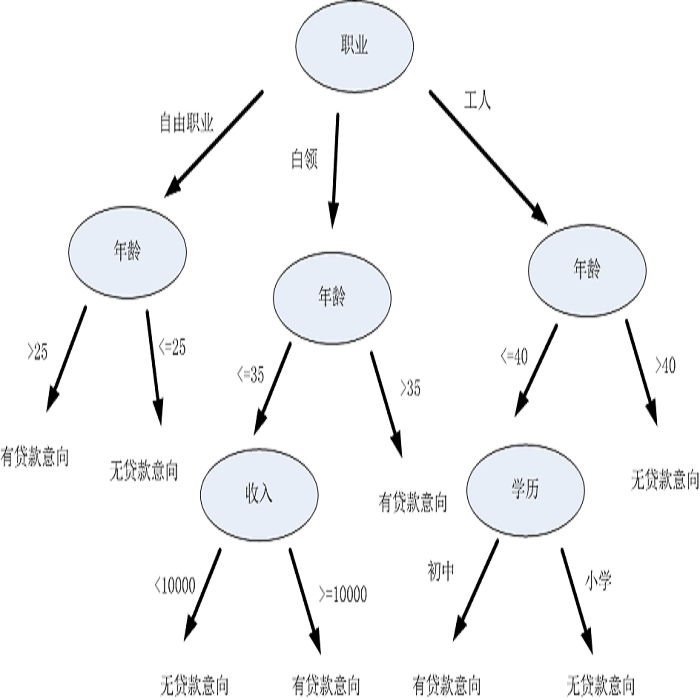
決策樹是一種樹形結構,其中每個內部節點表示一個屬性上的測試,每個分支代表一個測試輸出,每個葉節點代表一種類別。
分類樹(決策樹)是一種十分常用的分類方法。他是一種監管學習,所謂監管學習就是給定一堆樣本,每個樣本都有一組屬性和一個類別,這些類別是事先確定的,那么通過學習得到一個分類器,這個分類器能夠對新出現的對象給出正確的分類。這樣的機器學習就被稱之為監督學習。
Given its status as a classic problem and its importance to both theoreticians and practitioners, edit distance provides an excellent lens through which to understand how the theoretical analysis of algorithms impacts practical implementations. From an applied perspective, the goals of theoretical analysis are to predict the empirical performance of an algorithm and to serve as a yardstick to design novel algorithms that perform well in practice. In this paper, we systematically survey the types of theoretical analysis techniques that have been applied to edit distance and evaluate the extent to which each one has achieved these two goals. These techniques include traditional worst-case analysis, worst-case analysis parametrized by edit distance or entropy or compressibility, average-case analysis, semi-random models, and advice-based models. We find that the track record is mixed. On one hand, two algorithms widely used in practice have been born out of theoretical analysis and their empirical performance is captured well by theoretical predictions. On the other hand, all the algorithms developed using theoretical analysis as a yardstick since then have not had any practical relevance. We conclude by discussing the remaining open problems and how they can be tackled.
Minimum cut/maximum flow (min-cut/max-flow) algorithms solve a variety of problems in computer vision and thus significant effort has been put into developing fast min-cut/max-flow algorithms. As a result, it is difficult to choose an ideal algorithm for a given problem. Furthermore, parallel algorithms have not been thoroughly compared. In this paper, we evaluate the state-of-the-art serial and parallel min-cut/max-flow algorithms on the largest set of computer vision problems yet. We focus on generic algorithms, i.e., for unstructured graphs, but also compare with the specialized GridCut implementation. When applicable, GridCut performs best. Otherwise, the two pseudoflow algorithms, Hochbaum pseudoflow and excesses incremental breadth first search, achieves the overall best performance. The most memory efficient implementation tested is the Boykov-Kolmogorov algorithm. Amongst generic parallel algorithms, we find the bottom-up merging approach by Liu and Sun to be best, but no method is dominant. Of the generic parallel methods, only the parallel preflow push-relabel algorithm is able to efficiently scale with many processors across problem sizes, and no generic parallel method consistently outperforms serial algorithms. Finally, we provide and evaluate strategies for algorithm selection to obtain good expected performance. We make our dataset and implementations publicly available for further research.
Automated vehicles require the ability to cooperate with humans for smooth integration into today's traffic. While the concept of cooperation is well known, developing a robust and efficient cooperative trajectory planning method is still a challenge. One aspect of this challenge is the uncertainty surrounding the state of the environment due to limited sensor accuracy. This uncertainty can be represented by a Partially Observable Markov Decision Process. Our work addresses this problem by extending an existing cooperative trajectory planning approach based on Monte Carlo Tree Search for continuous action spaces. It does so by explicitly modeling uncertainties in the form of a root belief state, from which start states for trees are sampled. After the trees have been constructed with Monte Carlo Tree Search, their results are aggregated into return distributions using kernel regression. We apply two risk metrics for the final selection, namely a Lower Confidence Bound and a Conditional Value at Risk. It can be demonstrated that the integration of risk metrics in the final selection policy consistently outperforms a baseline in uncertain environments, generating considerably safer trajectories.
While algorithms for planar graphs have received a lot of attention, few papers have focused on the additional power that one gets from assuming an embedding of the graph is available. While in the classic sequential setting, this assumption gives no additional power (as a planar graph can be embedded in linear time), we show that this is far from being the case in other settings. We assume that the embedding is straight-line, but our methods also generalize to non-straight-line embeddings. Specifically, we focus on sublinear-time computation and massively parallel computation (MPC). Our main technical contribution is a sublinear-time algorithm for computing a relaxed version of an $r$-division. We then show how this can be used to estimate Lipschitz additive graph parameters. This includes, for example, the maximum matching, maximum independent set, or the minimum dominating set. We also show how this can be used to solve some property testing problems with respect to the vertex edit distance. In the second part of our paper, we show an MPC algorithm that computes an $r$-division of the input graph. We show how this can be used to solve various classical graph problems with space per machine of $O(n^{2/3+\epsilon})$ for some $\epsilon>0$, and while performing $O(1)$ rounds. This includes for example approximate shortest paths or the minimum spanning tree. Our results also imply an improved MPC algorithm for Euclidean minimum spanning tree.
In the realm of unsupervised learning, Bayesian nonparametric mixture models, exemplified by the Dirichlet Process Mixture Model (DPMM), provide a principled approach for adapting the complexity of the model to the data. Such models are particularly useful in clustering tasks where the number of clusters is unknown. Despite their potential and mathematical elegance, however, DPMMs have yet to become a mainstream tool widely adopted by practitioners. This is arguably due to a misconception that these models scale poorly as well as the lack of high-performance (and user-friendly) software tools that can handle large datasets efficiently. In this paper we bridge this practical gap by proposing a new, easy-to-use, statistical software package for scalable DPMM inference. More concretely, we provide efficient and easily-modifiable implementations for high-performance distributed sampling-based inference in DPMMs where the user is free to choose between either a multiple-machine, multiple-core, CPU implementation (written in Julia) and a multiple-stream GPU implementation (written in CUDA/C++). Both the CPU and GPU implementations come with a common (and optional) python wrapper, providing the user with a single point of entry with the same interface. On the algorithmic side, our implementations leverage a leading DPMM sampler from (Chang and Fisher III, 2013). While Chang and Fisher III's implementation (written in MATLAB/C++) used only CPU and was designed for a single multi-core machine, the packages we proposed here distribute the computations efficiently across either multiple multi-core machines or across mutiple GPU streams. This leads to speedups, alleviates memory and storage limitations, and lets us fit DPMMs to significantly larger datasets and of higher dimensionality than was possible previously by either (Chang and Fisher III, 2013) or other DPMM methods.
We define a new method for taking advantage of net reductions in combination with a SMT-based model checker. Our approach consists in transforming a reachability problem about some Petri net, into the verification of an updated reachability property on a reduced version of this net. This method relies on a new state space abstraction based on systems of constraints, called polyhedral abstraction. We prove the correctness of this method using a new notion of equivalence between nets. We provide a complete framework to define and check the correctness of equivalence judgements; prove that this relation is a congruence; and give examples of basic equivalence relations that derive from structural reductions. Our approach has been implemented in a tool, named SMPT, that provides two main procedures: Bounded Model Checking (BMC) and Property Directed Reachability (PDR). Each procedure has been adapted in order to use reductions and to work with arbitrary Petri nets. We tested SMPT on a large collection of queries used in the Model Checking Contest. Our experimental results show that our approach works well, even when we only have a moderate amount of reductions.
We present a massively parallel Lagrange decomposition method for solving 0--1 integer linear programs occurring in structured prediction. We propose a new iterative update scheme for solving the Lagrangean dual and a perturbation technique for decoding primal solutions. For representing subproblems we follow Lange et al. (2021) and use binary decision diagrams (BDDs). Our primal and dual algorithms require little synchronization between subproblems and optimization over BDDs needs only elementary operations without complicated control flow. This allows us to exploit the parallelism offered by GPUs for all components of our method. We present experimental results on combinatorial problems from MAP inference for Markov Random Fields, quadratic assignment and cell tracking for developmental biology. Our highly parallel GPU implementation improves upon the running times of the algorithms from Lange et al. (2021) by up to an order of magnitude. In particular, we come close to or outperform some state-of-the-art specialized heuristics while being problem agnostic. Our implementation is available at //github.com/LPMP/BDD.
Coflow is a network abstraction used to represent communication patterns in data centers. The coflow scheduling problem in large data centers is one of the most important $NP$-hard problems. Many previous studies on coflow scheduling mainly focus on the single-core model. However, with the growth of data centers, this single-core model is no longer sufficient. This paper considers the coflow scheduling problem in heterogeneous parallel networks. The heterogeneous parallel network is an architecture based on multiple network cores running in parallel. In this paper, two polynomial-time approximation algorithms are developed for scheduling divisible and indivisible coflows in heterogeneous parallel networks, respectively. Both algorithms achieve an approximation ratio of $O(\log m/ \log \log m)$ with arbitrary release times.
Task graphs provide a simple way to describe scientific workflows (sets of tasks with dependencies) that can be executed on both HPC clusters and in the cloud. An important aspect of executing such graphs is the used scheduling algorithm. Many scheduling heuristics have been proposed in existing works; nevertheless, they are often tested in oversimplified environments. We provide an extensible simulation environment designed for prototyping and benchmarking task schedulers, which contains implementations of various scheduling algorithms and is open-sourced, in order to be fully reproducible. We use this environment to perform a comprehensive analysis of workflow scheduling algorithms with a focus on quantifying the effect of scheduling challenges that have so far been mostly neglected, such as delays between scheduler invocations or partially unknown task durations. Our results indicate that network models used by many previous works might produce results that are off by an order of magnitude in comparison to a more realistic model. Additionally, we show that certain implementation details of scheduling algorithms which are often neglected can have a large effect on the scheduler's performance, and they should thus be described in great detail to enable proper evaluation.
Sparse decision tree optimization has been one of the most fundamental problems in AI since its inception and is a challenge at the core of interpretable machine learning. Sparse decision tree optimization is computationally hard, and despite steady effort since the 1960's, breakthroughs have only been made on the problem within the past few years, primarily on the problem of finding optimal sparse decision trees. However, current state-of-the-art algorithms often require impractical amounts of computation time and memory to find optimal or near-optimal trees for some real-world datasets, particularly those having several continuous-valued features. Given that the search spaces of these decision tree optimization problems are massive, can we practically hope to find a sparse decision tree that competes in accuracy with a black box machine learning model? We address this problem via smart guessing strategies that can be applied to any optimal branch-and-bound-based decision tree algorithm. We show that by using these guesses, we can reduce the run time by multiple orders of magnitude, while providing bounds on how far the resulting trees can deviate from the black box's accuracy and expressive power. Our approach enables guesses about how to bin continuous features, the size of the tree, and lower bounds on the error for the optimal decision tree. Our experiments show that in many cases we can rapidly construct sparse decision trees that match the accuracy of black box models. To summarize: when you are having trouble optimizing, just guess.
小貼士
登錄享
相關主題




注冊地址: 北京市海淀區羊坊店路18號2幢3層301-191